

1 big thing: A connected approach to family well-being

Efforts to support families, unfortunately, are too often designed and funded in separate lanes. Healthcare operates apart from early childhood education. Housing supports rarely connect with workforce training. Obtaining financial help, early learning, and benefit assistance often require navigating entirely different systems.
But that’s not how families live their lives.
A parent caring for a newborn might juggle doctor visits with efforts to secure child care, keep a job, pay rent, and cover basic needs. A dangerous consequence of this lack of connection is that even small setbacks can quickly snowball. A child care gap leads to missed work. Lost income strains housing stability.
Two of three American workers live paycheck to paycheck; more than half say they’ve lost faith in the American Dream — underscoring the widespread economic strain on families.
Ascend at the Aspen Institute’s Forward With Families initiative calls for policies based on how things connect to each other — not how agencies are organized.
Ascend is calling on its network of 1,000 organizations nationwide to attack the challenges on 5 fronts:
Advance whole-family approaches to physical, mental, and behavioral health that reflect the realities of caregiving and family life.
Treat child care and other caregiving as essential infrastructure so parents can work, learn, and support their families without impossible tradeoffs.
Redesign education and workforce systems to support working parents and create real pathways to economic mobility.
Shift from crisis response to prevention by aligning housing, nutrition, and family-support systems to stabilize families before hardship escalates.
Modernize income, tax, and benefits systems to reduce volatility, trust families, and provide the financial breathing room needed to move forward.
🙌 Victory would look like this: Families can afford reliable child care. Parents can work and pursue education. Such basic needs as having a safe, affordable place to live, nutritious food, and financial stability are within reach. When public policy supports these interconnected needs together — alongside early learning — families can focus on success instead of survival. Children grow up healthier, parents stay on track at work or in school, and public resources go farther.
2. Conversation with Laura Huerta Migus
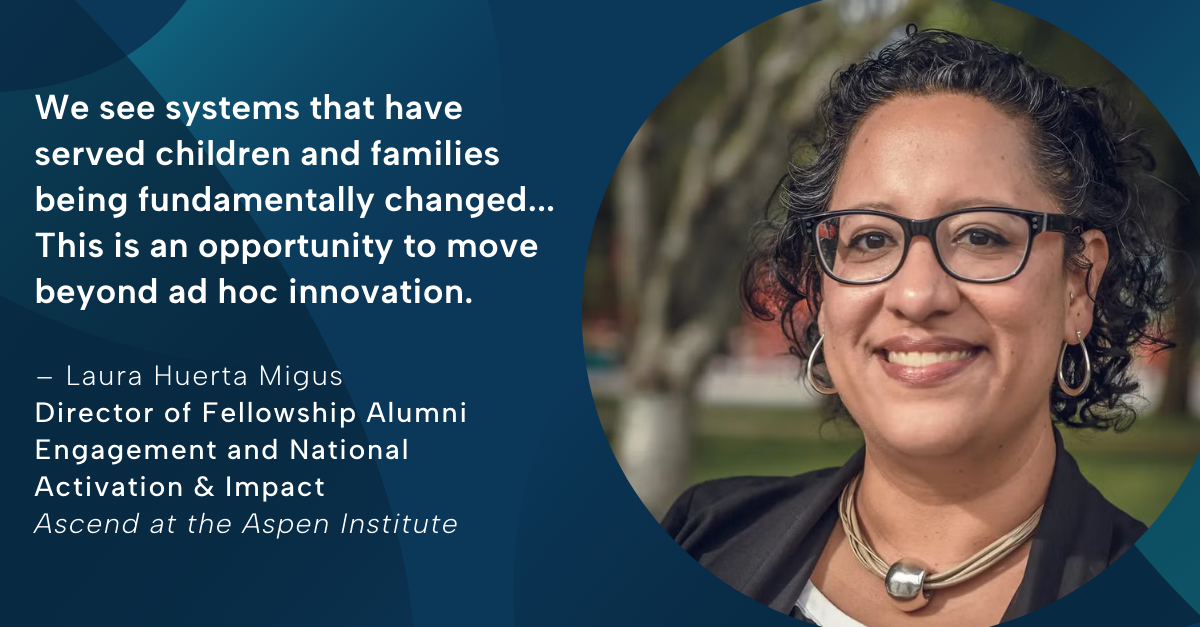
Laura Huerta Migus is Director of Fellowship Alumni Engagement and National Activation & Impact at Ascend at the Aspen Institute. An Ascend Fellow and former White House Champion of Change, she has experience in public-private partnerships, equity, and designing systems that work.
Forward With Families starts from what families have been saying for years: Life is expensive, supports are hard to navigate, and systems don’t connect.
What makes this moment different from past efforts to strengthen family policy?
Change is happening at a dramatic rate and pace everywhere and at all levels. We see systems that have served children and families being fundamentally changed at the federal level. Assumptions are being broken every day.
At the same time, we see innovation that’s been building over the past 10 years. There’s convergence among policy changes, global shifts, technological advances, and macroeconomic changes. We have the largest wealth gap in nearly a century.
Forward With Families feels necessary because all this change can be chaotic — for leaders, service providers, and families. People ask, “Where do we start?” This is an opportunity to move beyond ad hoc innovation and create a framework people can align around. We’re hearing clearly that people need that blueprint to navigate what comes next.
What have families shared that most shaped this strategy?
One of Ascend’s most important assets is our deep partnership with more than 80 parent advisors throughout the country. Centering family and parent voice is core to our values. Over the past year, as Ascend developed Forward With Families, we consistently went back to our parent advisors and drew on their insights.
What our 5 priority areas reflect comes directly from what families shared. Families talk about maintaining their health and wellbeing. They talk about access to high-quality education and good jobs. And about affordable child care and caregiving, especially for “sandwiched” parents who care for their children while also caring for older family members. They talk about access to food and stable housing. And they talk about building savings and having cash to move from surviving to thriving.
One of our parent advisors shared a powerful example. She earned a college degree and felt her family was on an upward trajectory. But, to take advantage of better job opportunities, she would need to move. The cost of moving was out of reach.
What’s a good example of a creative way to integrate services?
The New Jersey Department of Children and Families’ Keeping Families Together approach uses the power of the state housing authority to promote agency collaboration that better supports families.
When families need housing support, that’s not the only support they need. The power of coordination in Keeping Families Together means families get a range of services that help them move from surviving to thriving. We hold up this model, particularly for the public sector, to show what cross-system collaboration can look like in practice.
For funders, what’s needed to move from siloed programs to truly family-centered systems?
Philanthropy is such an important influencer in shifting mindset and assumptions. We’ve seen the power of funders who embrace whole-family or 2-generation approaches in their grantmaking.
That’s a different design paradigm from the traditional policy frame. And that shift requires learning. It requires experimentation. It requires time and room to try new approaches.
Public systems don’t always have that flexibility when they operate solely with public dollars. Philanthropy helps create space for leaders to learn and experiment — to build the muscles required for systems change.
What practical steps can organizations take to align systems around families?
Service providers often see families’ whole lives. That can feel overwhelming and make it hard to know where to start. Filtering what you’re seeing through your mission and naming the challenge in plain language is an important first step.
The second step is to never solve a problem that affects people without including them at the table. Organizations often wonder what the right process is for bringing in parent voice. But you don’t have to look far. You likely have parents on your staff. You have people in your close orbit navigating these systems. Bringing that voice into your decision making — even into how you define the problem — can be transformative.
New Jersey is embedding family voice at high levels. Commissioner of the state Department of Children & Families Christine Norbut Beyer — an Ascend Fellow — established practices to bring parent and family voice directly into the work.
Sometimes families state the challenge differently than institutions do. That shift in framing can open up clearer paths forward. As our parent advisors often say: “Don’t come to us with your idea of how to fix it. Ask us first.”
Go deeper: Check out more about the Forward With Families agenda.
3. Blueprint for affordable child care
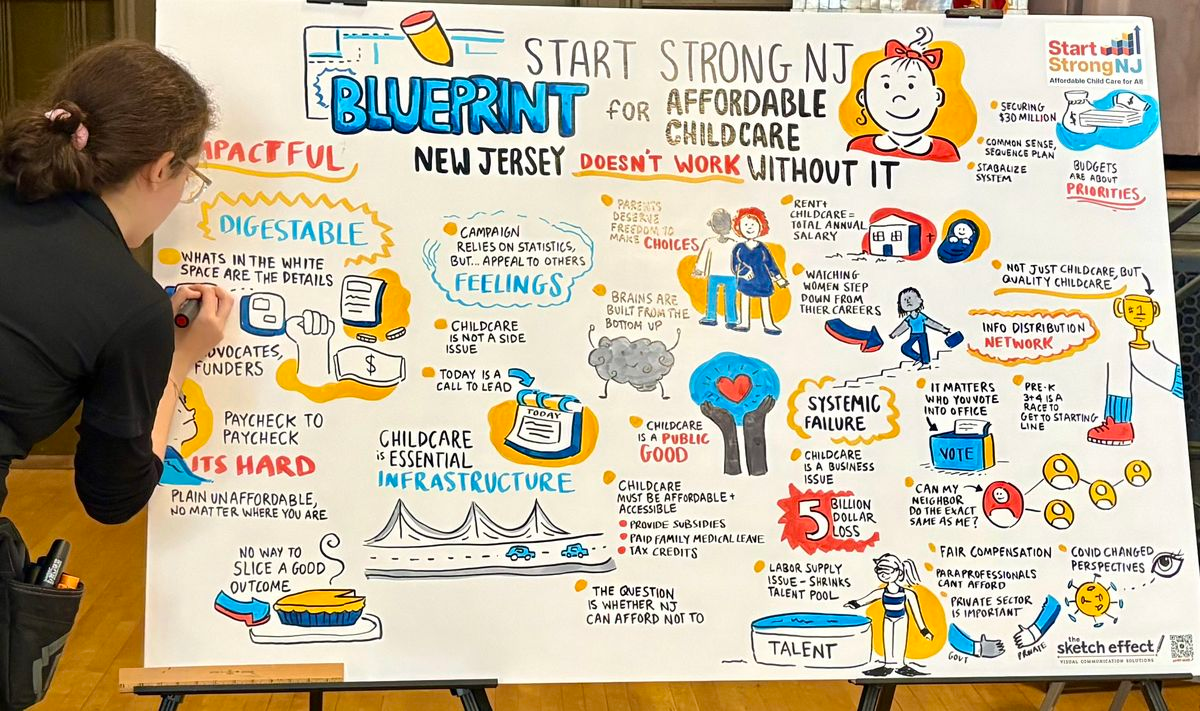
Last week, the Start Strong NJ campaign released Blueprint for Affordable Child Care: New Jersey Doesn’t Work Without It. It’s a common-sense plan reflecting 3 principles:
Child care must be affordable and accessible.
Educators must be compensated and supported as the professionals they are.
Child care must be recognized as essential economic infrastructure and funded accordingly.
Child care is often the largest expense for many families, and they can’t afford it. Educators are underpaid. Providers struggle to stay open. The result is a fragile structure that undermines workforce participation, economic mobility, and child well-being — and costs New Jersey $5 billion a year in lost wages, productivity, and tax revenue.
Jackie Mack — a working mother of 2 — put real-life numbers to the issue. Child care costs Jackie and her husband $3,200 a month — more than their $2,700 rent. That’s $38,400 a year.
As she told an audience of educators, advocates, and legislators at the Start Strong NJ blueprint launch in Trenton: “We earn too much to qualify for assistance, yet not enough for child care to feel affordable. The truth is child care is our largest monthly expense.”
Among the Blueprint’s key recommendations:
✔ Fully fund the state’s child care subsidy program
✔ Update eligibility rules to reflect the cost of living
✔ Establish a state-funded compensation framework for educators
✔ Build a long-term, sustainable financing strategy
✔ Establish a blue-ribbon commission on child care and early learning
At the launch, Lt. Gov. Dr. Dale G. Caldwell shared Gov. Mikie Sherrill’s commitment to making child care work for New Jerseyans: “Governor Sherrill and I talk about affordability at every level, and it starts with child care…Let’s make New Jersey a model of child care.”
The bottom line: Child care is too big a problem for families to solve on their own. It’s not a luxury or niche social service. It enables people to work, businesses to succeed, and communities to thrive.
👉 Read the Blueprint: Explore the recommendations, and join the Start Strong NJ campaign for affordable child care.